The Road Not Taken: Decoding Robert Frost's Iconic Poem and Its Enduring Message
Robert Frost's "The Road Not Taken" is arguably one of the most quoted and often misinterpreted poems in the English language. While many interpret it as a celebration of individualism and choosing the unconventional path, a closer examination reveals a more nuanced and complex message about decision-making, regret, and the human tendency to romanticize the past. This poem isn't simply about choosing the less traveled road; it's about the stories we tell ourselves about the choices we make.
The Road Not Taken By Robert Frost Quotes
In this comprehensive guide, we'll delve deep into the poem's themes, symbolism, and historical context, exploring its true meaning and its relevance to our lives today. We'll also analyze key quotes and phrases, dissecting their layers of interpretation and providing practical insights on how to apply the poem's lessons to your own journey.
Why "The Road Not Taken" Still Resonates Today
Decades after its publication, "The Road Not Taken" continues to captivate readers. It touches upon universal human experiences: the weight of choices, the desire for uniqueness, and the inevitable "what ifs" that linger in our minds. The poem's deceptively simple language belies a profound exploration of the human condition.
- The allure of individualism: In a world that often pressures us to conform, the poem speaks to our desire to stand out and forge our own paths.
- The complexity of choices: Life is filled with crossroads, and "The Road Not Taken" acknowledges the difficulty of knowing which path is truly best.
- The human tendency to romanticize: The poem subtly reveals how we often rewrite our past, imbuing our decisions with a significance they may not have held at the time.

A Stanza-by-Stanza Analysis: Unpacking the Poem's Meaning
Let's break down "The Road Not Taken" stanza by stanza, examining the language and imagery Frost employs.
Stanza 1:
"Two roads diverged in a yellow wood, And sorry I could not travel both And be one traveler, long I stood And looked down one as far as I could To where it bent in the undergrowth;"
The poem opens with the speaker encountering a fork in the road in a "yellow wood," suggesting autumn and a time of transition. The speaker expresses regret at not being able to travel both paths, highlighting the inherent limitations of choice. The act of looking down one road "as far as I could" symbolizes the attempt to foresee the consequences of a decision, an effort that is ultimately limited by the unknown future.
Stanza 2:
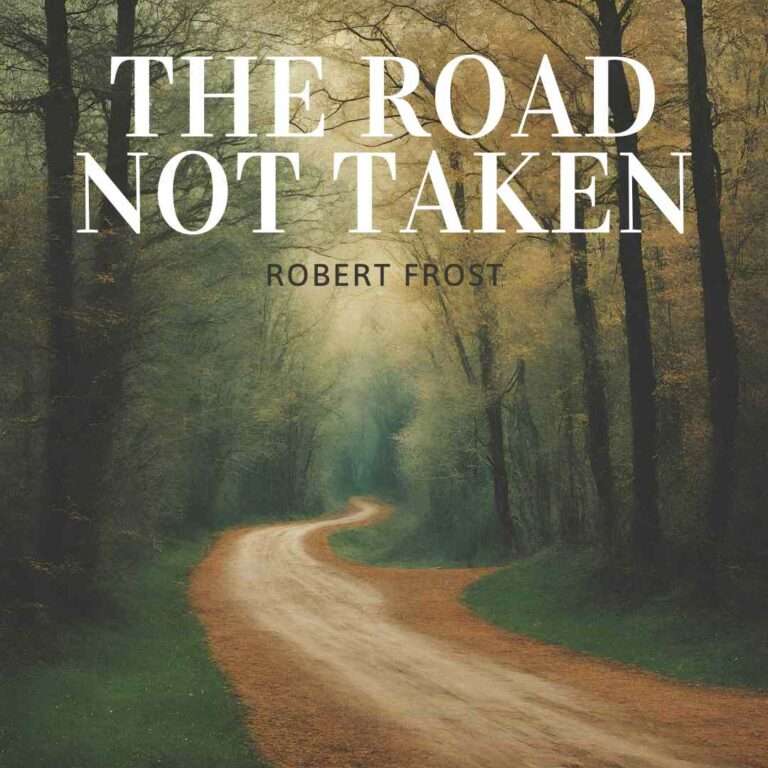
"Then took the other, as just as fair, And having perhaps the better claim, Because it was grassy and wanted wear; Though as for that the passing there Had worn them really about the same,"
This stanza introduces the central "road not taken" imagery. The speaker chooses the road that "was grassy and wanted wear," seemingly suggesting a less traveled path. However, the lines "Though as for that the passing there / Had worn them really about the same" introduce ambiguity. This suggests that the speaker's perception of the road being less traveled might be a self-deception, a narrative constructed after the fact.
Stanza 3:
"And both that morning equally lay In leaves no step had trodden black. Oh, I kept the first for another day! Yet knowing how way leads on to way, I doubted if I should ever come back."
This stanza reinforces the idea that the two roads were actually quite similar at the time of the decision. "Both that morning equally lay / In leaves no step had trodden black" emphasizes the initial lack of distinction between the paths. The speaker's intention to "keep the first for another day" is immediately undercut by the realization that life rarely allows us to revisit our choices. "Knowing how way leads on to way" acknowledges the irreversible nature of time and the branching possibilities that arise from each decision.
Stanza 4:
"I shall be telling this with a sigh Somewhere ages and ages hence: Two roads diverged in a wood, and I— I took the one less traveled by, And that has made all the difference."
The final stanza is the most controversial and often misinterpreted. The speaker imagines recounting this experience "ages and ages hence," suggesting a future where the decision takes on a legendary quality. The line "I took the one less traveled by, / And that has made all the difference" is often read as a triumphant affirmation of individualism. However, the preceding "I shall be telling this with a sigh" introduces a note of regret or wistfulness. The "difference" the speaker claims might be a self-serving narrative, a way to justify the past and create a sense of meaning.
Key Quotes and Their Deeper Meanings
- "Two roads diverged in a yellow wood": This opening line sets the scene for a moment of decision and highlights the theme of choices and their consequences. The "yellow wood" suggests a time of transition and reflection.
- "I took the one less traveled by": This is the most famous line of the poem, often interpreted as an endorsement of individualism. However, as we've seen, the poem suggests this might be a simplification or even a distortion of the truth.
- "And that has made all the difference": This line is the culmination of the speaker's reflection and the source of much debate. Is the "difference" a real outcome of the choice, or a narrative the speaker has constructed to make sense of the past?
- "I shall be telling this with a sigh": This subtle phrase is crucial to understanding the poem's complexity. The "sigh" suggests a sense of regret, wistfulness, or even resignation. It undermines the triumphant interpretation of the final lines.
The Poem's Ambiguity: Is It About Regret or Triumph?
"The Road Not Taken" is not a straightforward celebration of individualism. Its power lies in its ambiguity. Frost masterfully leaves the interpretation open to the reader.
- The case for regret: The "sigh" in the final stanza, the acknowledgement that the roads were "really about the same," and the recognition that the speaker may never return to the other road all point to a sense of regret. The poem could be seen as a cautionary tale about the human tendency to romanticize the past and create narratives that justify our choices.
- The case for triumph: The line "I took the one less traveled by, / And that has made all the difference" can be interpreted as a genuine affirmation of the speaker's choice. Perhaps the speaker, despite any lingering doubts, ultimately believes that their decision shaped them into the person they are today.
The Importance of Context: Understanding Frost's Intentions
Understanding the context in which Frost wrote "The Road Not Taken" can shed light on its meaning. The poem was originally written as a gentle jab at Frost's friend, Edward Thomas, who was known for his indecisiveness and his tendency to second-guess his choices.
- A playful critique: Frost intended the poem to be a humorous commentary on Thomas's habit of always wondering about the paths not taken.
- A broader observation: While the poem originated as a personal observation, it evolved into a broader reflection on human nature and the complexities of decision-making.
Applying the Lessons of "The Road Not Taken" to Your Life
"The Road Not Taken" offers valuable lessons for navigating life's choices and embracing the uncertainties of the future.
- Accept the limitations of choice: Recognize that you can't always know the outcome of your decisions and that regret is a natural part of the human experience.
- Be mindful of your narratives: Be aware of the stories you tell yourself about your past choices. Are you romanticizing the past or creating narratives that serve your current needs?
- Embrace the present: Focus on making the best decisions you can in the present moment, rather than dwelling on the "what ifs" of the past.
- Don't be afraid to deviate from the norm: While the poem cautions against blindly following the "less traveled road" simply for the sake of it, it also encourages us to consider alternative paths and to trust our own instincts.
- Realize that sometimes the roads are equally worn: It's okay to acknowledge that sometimes there isn't a clear "right" or "wrong" choice. Often, the paths we choose shape us more than the paths themselves.
Common Mistakes to Avoid When Interpreting the Poem
- Taking the poem at face value: Avoid reading "The Road Not Taken" as a simple endorsement of individualism without considering its nuances and ambiguities.
- Ignoring the "sigh": Don't overlook the significance of the "sigh" in the final stanza, as it adds a layer of complexity and potential regret to the speaker's reflection.
- Oversimplifying the meaning: Recognize that the poem is not about finding the "best" path, but about the process of decision-making, the human tendency to romanticize the past, and the acceptance of uncertainty.
Pro tips from us: When faced with a difficult decision, try to gather as much information as possible, but also trust your intuition. Remember that there is rarely a perfect choice, and that the most important thing is to learn from your experiences and move forward with confidence.
External Resource: For a deeper dive into Robert Frost's life and work, visit the Poetry Foundation: https://www.poetryfoundation.org/poets/robert-frost
Conclusion: Embracing the Journey, Regardless of the Road
"The Road Not Taken" is a powerful and enduring poem because it speaks to the complexities of human experience. It reminds us that choices are rarely simple, that regret is inevitable, and that the stories we tell ourselves about our past shape our present and future. While the poem's meaning remains open to interpretation, its message is clear: embrace the journey, learn from your choices, and find meaning in the road you have traveled, regardless of whether it was the "one less traveled by."
Ultimately, "The Road Not Taken" isn't about the road itself, but about the traveler's journey and the story they choose to tell. It's a poem that encourages us to reflect on our own choices, to embrace the uncertainties of life, and to find meaning in the paths we have chosen, even if they were not always the easiest or most conventional.
I hope this in-depth exploration of "The Road Not Taken" has been insightful and helpful. Remember to share this article with fellow poetry enthusiasts and anyone seeking a deeper understanding of this iconic poem.